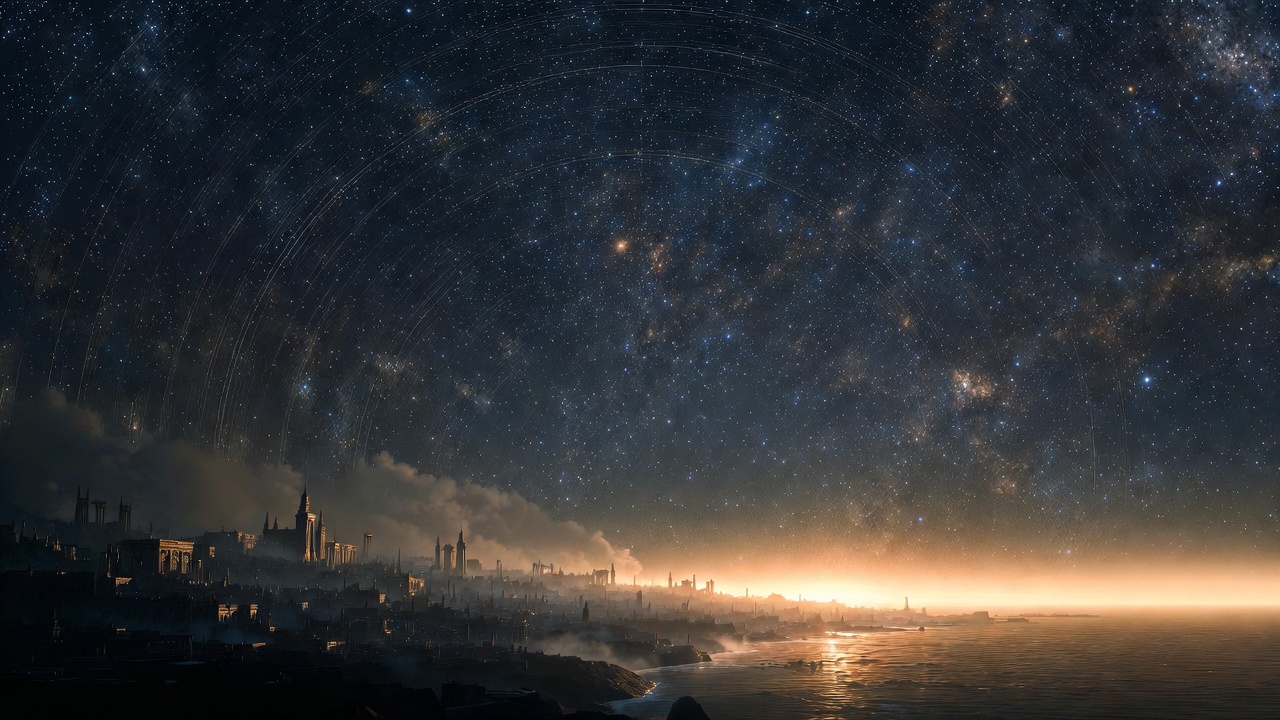
A count of the stars, kept faithfully across generations, until the record itself becomes the story.
The Age of Expansion begins with a small, almost domestic act: a young priest climbs a bell-tower, counts the stars, and does not like the number he gets. He writes it down anyway. That single stubborn habit, repeated across centuries and descendants, is the entire engine of this novel, and it is why we wanted it in the Aphelion catalog.
Most cosmic-scale science fiction earns its size through spectacle: fleets, empires, superweapons. The Age of Expansion earns its size the slow way, through inheritance. A journal passed from hand to hand. A column of numbers nobody was supposed to keep. A family that cannot stop noticing what the sky is doing, long after everyone around them has decided it is safer not to look.
The sky was not lying. It was the only honest thing left in the room, and almost no one wanted to hear what it was saying.
A record instead of a warning
What struck us first about Lila Westwood's novel is how little it relies on prophecy or dread. Caelan Arlen, the priest who starts the record, is not trying to save the world. He is trying to be accurate. He counts stars the way a baker weighs flour, and the book trusts that discipline enough to build an entire cosmology out of it.
That restraint pays off across the generations that follow him. Scholars, scientists, broadcasters, and skeptics inherit the same journal and the same unresolved question, and each of them has to decide, in the vocabulary of their own century, whether to keep counting or to look away. The novel never rushes past that decision. It treats patience as a form of courage.
Faith, mathematics, and the trouble with both
The book also refuses to let doctrine and evidence stay comfortably separated. Priests do the counting. Soldiers carry old hymns that turn out to describe the sky more accurately than any chart. A baker offers the best theological insight in the first act, simply by paying attention to bread yields. The Age of Expansion keeps insisting that the sacred and the empirical are asking the same question from different rooms.
By the time the later generations arrive at their instruments, their broadcasts, and their final models, the novel has earned something rare: a sense that the truth about the universe was always available to anyone patient enough to keep looking, and that the real drama was never the secret itself, but who was willing to write it down.
Why we keep returning to it
The Age of Expansion is the kind of science fiction we built this press for: a premise with real intellectual weight, carried by people who feel like they could have existed. It moves from a single bell-tower to the edge of everything, and it never once forgets that the edge of everything is still made up of people who inherited a habit, a question, and a book they were afraid to close.