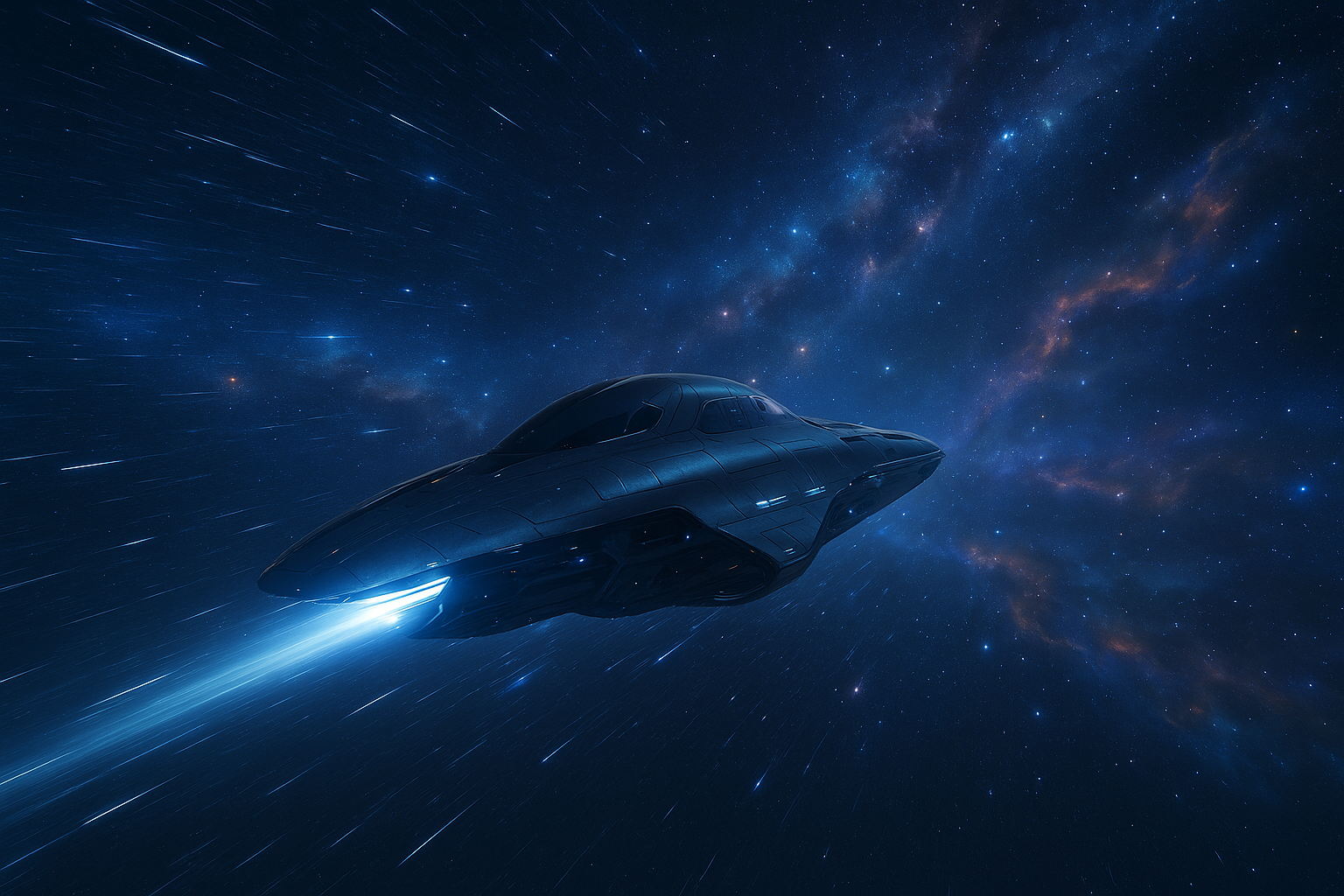
How will humanity react when we finally encounter intelligent alien life?
The moment humanity makes contact with intelligent alien life will be the most significant event in our species' history. Science fiction has been rehearsing this scenario for over a century, exploring every possible outcome from apocalyptic invasion to transcendent communion.
These first contact stories reveal as much about ourselves as they do about imagined aliens. They reflect our deepest fears—of the unknown, of obsolescence, of annihilation—and our highest hopes for connection, understanding, and cosmic companionship. From H.G. Wells' terrifying Martians to Ted Chiang's linguistic aliens, first contact scenarios have evolved alongside our understanding of the universe and ourselves.
Let's explore the major categories of first contact in science fiction, what makes each approach compelling, and what these stories tell us about the human condition.
The Hostile Invasion: When They Come to Conquer
The hostile alien invasion remains one of science fiction's most enduring tropes. H.G. Wells' The War of the Worlds (1898) established the template: technologically superior aliens arrive with no interest in communication, only conquest. The story tapped into Victorian anxieties about imperialism—what if humanity found itself on the receiving end of colonization?
This archetype has proven remarkably durable. From the body-snatching pods in Invasion of the Body Snatchers to the relentless xenomorphs in the Alien franchise, hostile first contact scenarios explore our vulnerability in a vast, potentially hostile universe.
Modern Takes on Invasion
Contemporary invasion narratives have grown more sophisticated. Liu Cixin's The Three-Body Problem trilogy presents the "Dark Forest" theory—the idea that any civilization revealing itself in the cosmos risks immediate annihilation from more advanced species. The Trisolarans aren't evil; they're desperate survivors playing by the universe's brutal rules.
Adrian Tchaikovsky's Children of Time flips the script entirely, showing humanity as the potential invaders encountering an uplifted spider civilization. These nuanced approaches force us to question who the real threat might be.
Why Invasion Stories Endure
Hostile first contact scenarios tap into primal fears while allowing authors to explore themes of survival, resilience, and what it means to be human when faced with existential threats. They're also thrilling page-turners that combine action with philosophical depth.
The Peaceful Exchange: Hope Among the Stars
Not all first contact stories end in warfare. Some of science fiction's most profound works imagine aliens as potential partners, teachers, or even saviors. Arthur C. Clarke's Childhood's End presents the Overlords—benevolent aliens who guide humanity toward transcendence, albeit at the cost of our independence.
Carl Sagan's Contact offers perhaps the most optimistic vision of first contact. When Dr. Ellie Arroway receives a message from Vega, it contains instructions for building a machine that will allow humanity to join a galactic community. The aliens aren't interested in conquest or even direct intervention—they simply want to welcome us to the cosmic conversation.
The Challenge of Communication
Peaceful first contact often hinges on the monumental challenge of communication. How do you establish dialogue with a species that evolved under completely different conditions? Ted Chiang's novella Story of Your Life (adapted into the film Arrival) makes linguistics the heart of first contact.
The heptapods in Chiang's story perceive time non-linearly, and learning their language fundamentally alters human consciousness. This represents first contact at its most transformative—not just meeting aliens, but being changed by the encounter in ways we can't predict.
"The universe is probably littered with the one-planet graves of cultures which made the sensible economic decision that there's no good reason to go into space—each discovered, studied, and remembered by the ones who made the irrational decision." — Randall Munroe
The Incomprehensible Other: When Understanding Fails
Some of the most unsettling first contact stories involve aliens so foreign that meaningful communication proves impossible. Stanisław Lem's Solaris features a sentient ocean that defies all human attempts at understanding. The planet isn't hostile—it simply operates on principles completely alien to human cognition.
This category of first contact story challenges our anthropocentric assumptions. We imagine aliens as either friends or enemies, but what if they're neither? What if they're so different that our categories of thought simply don't apply?
The Limits of Human Understanding
Peter Watts' Blindsight takes this concept to its logical extreme. The aliens humanity encounters—the scramblers—may be intelligent without being conscious. They're biological machines optimized for survival, lacking any inner experience. How do you negotiate with something that has no concept of self?
These stories force us to confront the possibility that intelligence might take forms we can't recognize, let alone communicate with. They're humbling reminders that the universe doesn't owe us comprehensibility.
The Accidental Encounter: Stumbling Into the Unknown
Not all first contact is planned. Some of the most compelling scenarios involve humans accidentally stumbling upon alien life—or aliens stumbling upon us. These stories often emphasize humanity's unpreparedness for cosmic contact.
In Becky Chambers' The Long Way to a Small, Angry Planet, humanity is already part of a galactic community, but individual first contacts still happen as characters encounter new species. The focus shifts from species-level diplomacy to personal relationships, making the cosmic intimate.
Mary Doria Russell's The Sparrow presents first contact as a religious mission gone tragically wrong. A Jesuit expedition to an alien world discovers two species in a complex relationship, but cultural misunderstandings lead to catastrophe. The novel asks whether some gulfs are simply too wide to bridge.
What First Contact Stories Reveal About Humanity
Every first contact scenario is ultimately a mirror. When we imagine how aliens might react to us—or how we might react to them—we're exploring fundamental questions about human nature.
- Our Capacity for Violence: Invasion stories force us to confront our own history of conquest and colonization.
- Our Desire for Connection: Peaceful contact scenarios reflect our deep need to not be alone in the universe.
- Our Cognitive Limits: Incomprehensible aliens remind us that reality might exceed our ability to understand it.
- Our Adaptability: Stories of successful contact celebrate humanity's ability to learn, grow, and change.
- Our Arrogance: Failed contact scenarios often stem from assuming aliens will think like us—or that we're special.
The best first contact stories don't just ask "what if we met aliens?" They ask "who are we, really?" They use the alien encounter as a lens to examine our values, our fears, and our potential.
Writing Believable First Contact Scenarios
For writers crafting their own first contact stories, several principles can help create compelling, believable scenarios:
Make the Aliens Truly Alien
The temptation is to create aliens that are essentially humans with different appearances. The most memorable aliens in fiction are those with genuinely different biologies, psychologies, and motivations. Consider how their evolutionary history would shape their values and behaviors.
Consider the Communication Challenge
How will your characters establish communication? What assumptions might fail? The struggle to understand can be as dramatic as any space battle. Worldbuilding extends to creating alien languages and communication methods.
Explore Multiple Perspectives
First contact affects different people differently. Scientists, politicians, religious leaders, and ordinary citizens will all have distinct reactions. Showing multiple viewpoints creates a richer, more realistic portrayal.
Ground the Fantastic in Real Science
Even in speculative scenarios, grounding your story in real science—whether it's quantum physics, linguistics, or astrobiology—adds credibility and depth.
Pro Tip for Writers
The most powerful first contact stories aren't about the aliens—they're about how the encounter changes humanity. Focus on transformation, whether it's personal, cultural, or species-wide. The alien is the catalyst; the human response is the story.
The Future of First Contact Fiction
As our understanding of the universe expands, so do our first contact stories. The discovery of thousands of exoplanets has made the possibility of alien life feel more real than ever. Meanwhile, advances in artificial intelligence raise new questions: what if our first contact isn't with biological aliens but with artificial ones?
Contemporary authors are exploring AI and consciousness in ways that blur the line between first contact and technological singularity. If we create artificial intelligence that surpasses human understanding, is that not a form of first contact?
Climate change and ecological crisis have also influenced recent first contact narratives. Stories increasingly ask: will aliens find us worthy of contact? What if our treatment of our own planet disqualifies us from joining a galactic community?
Key Takeaways
First contact scenarios in science fiction range from hostile invasions to peaceful exchanges, from comprehensible aliens to utterly foreign intelligences. Each approach offers unique insights into the human condition and our place in the cosmos.
Whether you're a reader exploring these themes or a writer crafting your own first contact story, remember that the best scenarios use the alien encounter as a mirror to examine who we are and who we might become.
The question isn't just "what will happen when we meet aliens?" It's "what will we discover about ourselves in the process?" That's the enduring power of first contact fiction—it's ultimately a story about humanity's potential, for better or worse.